
Turf Reinforcement Mats (TRM & HPTRM)
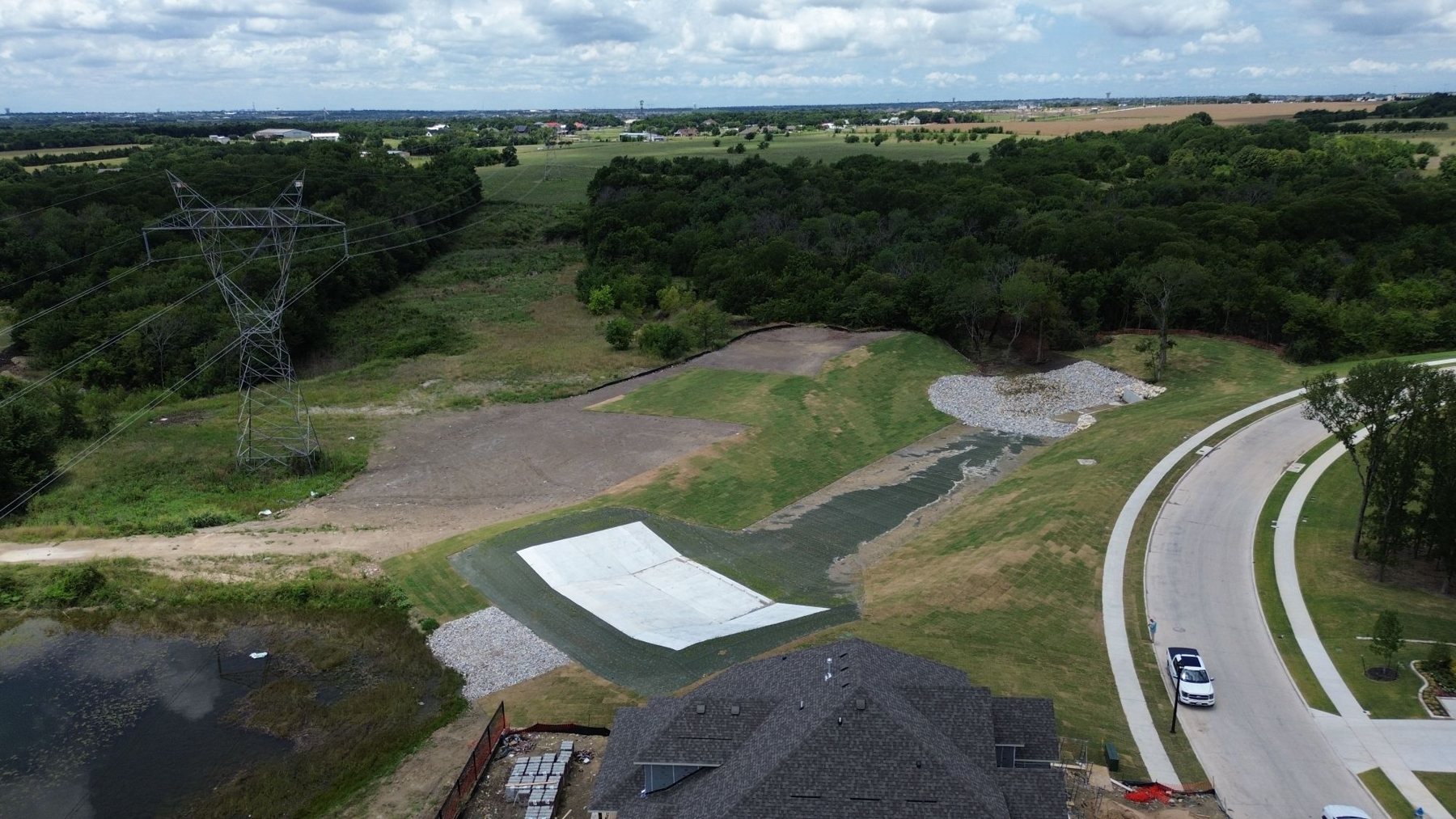
Some ground never gets to rest. A drainage channel, a spillway, a steep face that funnels every storm — these carry concentrated flow long after the grass has grown, and a biodegradable blanket that breaks down in a season leaves them exposed again. A turf reinforcement mat is what stays. Terradyne installs turf reinforcement mats across Dallas–Fort Worth where the erosion never really stops and the lining has to be permanent.
What is a turf reinforcement mat?
A turf reinforcement mat is a permanent RECP that stays in the soil and reinforces the roots that grow through it. Turf reinforcement mats are permanent mats that give long-term protection against wind and water erosion. Erosion control blankets are degradable rolled erosion control products (RECPs), while turf reinforcement mats are RECPs that contain synthetic components.
One family, three durations
The mat is the top of a ladder of rolled products, sorted by how long they last. Rolled erosion control products are classified as short-term, long-term, or turf reinforcement mats. The short- and long-term products are the degradable blankets that hand their job to vegetation and disappear; the mat is the one that never leaves, because the vegetation it holds still needs backup.
Where a blanket stops and a mat starts
The dividing line is written into the regional detail itself. The iSWM erosion control blanket staple pattern is specified for slope protection, not channels. That is the tell: a blanket is a slope tool. Where a slope only needs cover until grass takes hold, a degradable blanket does the job; where a channel carries concentrated flow year-round, a permanent turf reinforcement mat is what holds. If your problem is really a slope waiting on grass, start with Erosion Control Blankets instead.
Built for concentrated flow
Mats go exactly where the water gathers. Rolled erosion control products are commonly applied to channel and ditch linings, slopes, culvert inlets and outfalls, riverbanks, and levees. Those are the places a bare vegetated surface fails first. Heavy-duty turf reinforcement mats give permanent protection in critical areas where vegetation alone needs extra protection from shear-stress forces. The mat and the root network grow into one another, so the finished lining resists the pull of flowing water that would tear a plain grass channel apart.
Rated, not guessed
A permanent channel lining is an engineered choice, and mats carry engineered numbers. Turf reinforcement mat tensile strength is measured using the ASTM D6818 test method. That is how a designer matches a mat to a channel's expected velocity instead of hoping. And the mat earns its place against the permit's endgame. Final stabilization under TXR150000 requires uniform perennial vegetative cover of at least 70% of native background density, or equivalent permanent stabilization measures. A vegetated mat is one of the ways a channel that will never be paved still reaches permanent stabilization.
The high-performance tier (HPTRM)
Not every channel is equal, and the hardest ones get the strongest mats. For the highest-shear channels, spillways, and steep slopes, high-performance mats such as Pyramat and fully anchored systems like Armormax step up from a standard turf reinforcement mat. These are the systems for the spillway that has to survive the design storm, not just the average one.
The systems we target
Brand names matter here because channel designs specify them. The Propex lineup runs from the Armormax engineered earth armoring system through Pyramat 25 (TRM) and Pyramat 75 (HPTRM). Western Excelsior's PP5 line of permanent turf reinforcement mats runs PP5-8, PP5-10, PP5-12, PP5-Pro, and PP5-Xtreme, alongside the Xtreme Armor System. Terradyne targets and installs both families — Propex Armormax and Pyramat, and the Western Excelsior PP5 series through the Xtreme Armor System. Bring the spec sheet or the shear numbers — if the design names one of these systems, we install to its manual; if it does not yet, the numbers will point at one.
How Terradyne installs
Terradyne installs turf reinforcement mats to the manufacturer's specification and the channel or slope design for the site. A mat is only as good as its anchor trench and its contact with the soil, so the install follows the design that was engineered for the flow, not a generic roll-out.
What a failing channel lining looks like
The warning signs show up before a channel blows out. A mat that has lifted at the edge, flapping where the anchor trench was cut too shallow, is the first thing the next storm will peel back. Bare stripes running between mat rows mean the seams were lapped short and the flow found the gap. And a channel bottom scoured into a rut under an intact-looking mat means the mat never made real contact with the soil it was meant to reinforce — it bridged, and the water went to work underneath it. Every one of those is an install detail, not a product defect, which is exactly why the anchor trench and the soil contact get walked before the crew leaves the site.
Frequently Asked Questions
What is the difference between a turf reinforcement mat and an erosion control blanket?
A blanket is degradable and temporary — it holds seed on a slope, then breaks down. A mat is permanent and reinforced, built for channels and high-flow areas where the lining has to keep working for the life of the site. Slopes take blankets; channels take mats.
When do I need a turf reinforcement mat instead of a blanket?
When the ground carries concentrated flow that will not stop — drainage channels, ditch linings, spillways, culvert outfalls, and steep faces that funnel runoff. If a plain grass surface would scour there, the vegetation needs the permanent backup a mat provides.
What is an HPTRM?
A high-performance turf reinforcement mat, built for the highest-shear channels and spillways. High-performance systems step up from a standard mat where velocities and shear stress are too high for ordinary vegetated linings — the products a designer specifies when the channel has to survive the design storm.
Do turf reinforcement mats count as permanent stabilization?
A vegetated mat is a permanent stabilization method for surfaces that will never be paved. It reinforces the vegetation that provides the cover, so a channel or slope can reach and hold the permit's permanent-stabilization standard.
Request a bid
Send your channel or slope design to bids@terradynegroup.com or call (214) 878-7392 for turf reinforcement mat installation across Dallas–Fort Worth. Tell us the channel geometry and design flow, and we will match the mat to the job. The full Erosion Control division and the Stabilization & Revegetation group cover the controls that work alongside it.