
Propex Armormax Installation
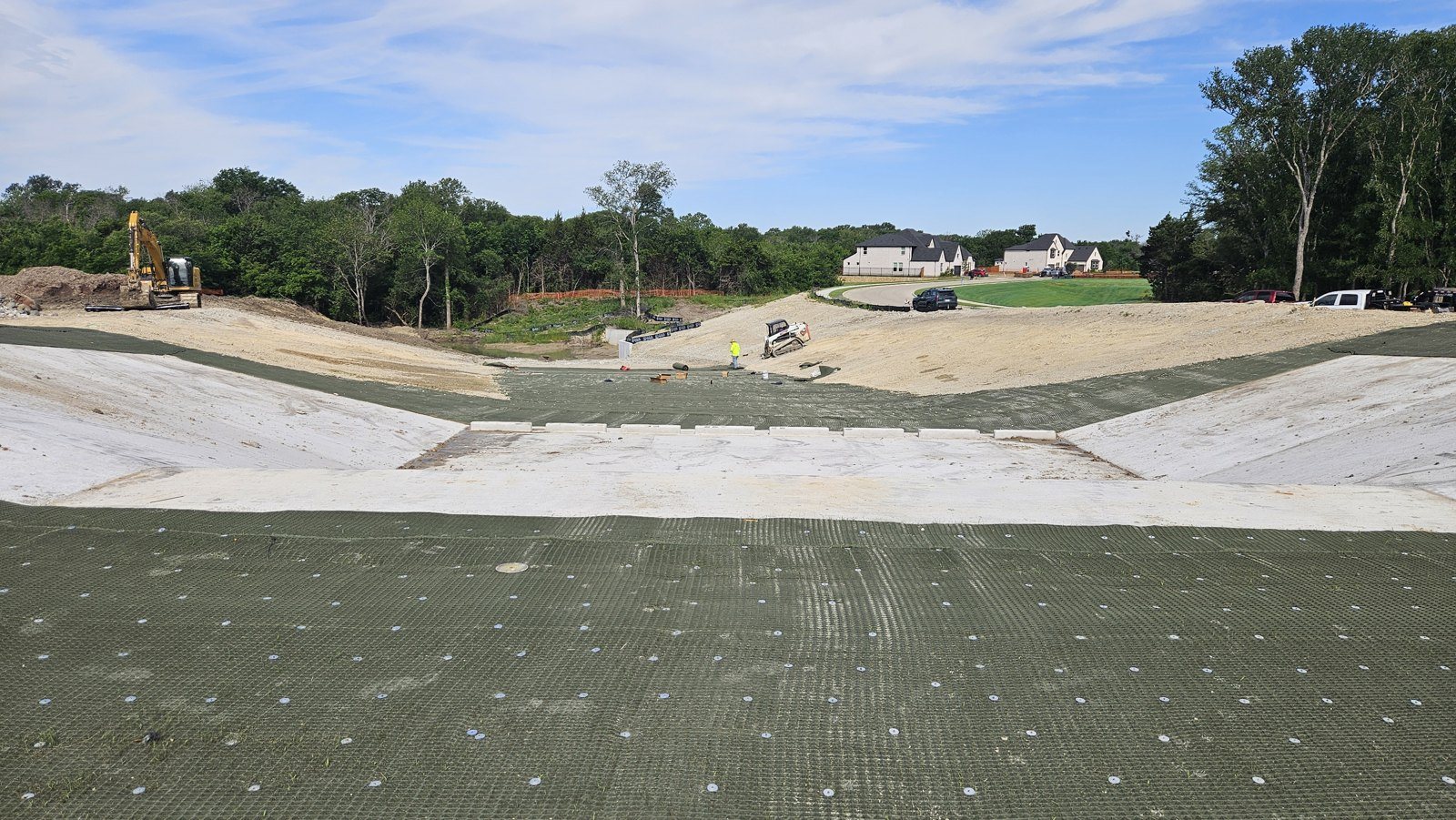
Armormax is for the slope that cannot be allowed to move — the reinforced face over infrastructure, the channel bank behind a structure, the grade whose failure costs more than its armor. It is the top of the vegetated-armor ladder: an engineered system rather than a product rolled off a truck. Terradyne installs Armormax across Texas where the design calls for the strongest green answer there is.
What is Armormax?
Armormax is an engineered earth-armoring system built around a high-performance mat, specified for the slopes and channels where surface protection alone is not enough. Terradyne installs Armormax, a high-performance turf reinforcement mat system — a permanent woven synthetic matrix, vegetated through, with an earth-anchor system.
The mat is the surface; the anchors are the difference; the vegetation is the finish that makes all of it read as a green slope. Nothing about the finished face advertises what it can withstand — which is exactly what the owners of critical slopes are usually buying.
Anchored, not just covered
What separates a system from a mat is what ties it to the ground. Terradyne installs Armormax with its earth-anchor system, edges buried and panels overlapped. The anchors are the difference: where an ordinary mat holds the surface, the anchored system is specified to engage the ground beneath it — slope reinforcement, not just cover. That is why the system shows up on faces where surface protection alone was never going to be enough — the anchor pattern is what the design leans on.
The heavy-duty tier
Armormax sits at the top of the same product family as the standard mats. Heavy-duty turf reinforcement mats give permanent protection in critical areas where vegetation alone needs extra protection from shear-stress forces. Turf reinforcement mats are permanent mats that give long-term protection against wind and water erosion. Where a standard mat handles the ordinary channel, the high-performance tier takes the spillways, the steep faces, and the flows that would strip anything lighter — the everyday version of that ladder lives on our Turf Reinforcement Mats (TRM) page.
Vegetation as the finish line
For all its engineering, the system's public face is grass — and that is also its compliance story. Final stabilization under TXR150000 requires uniform perennial vegetative cover of at least 70% of native background density, or equivalent permanent stabilization measures. An established Armormax face carries vegetative cover with a reinforced spine, which is how a slope can be both a green surface and an engineered structure at once.
Where it earns its keep
The system belongs where the stakes justify it: slopes above roads and utilities, channel banks protecting structures, dam and levee faces, repairs where a grade has already failed once. On those faces the question is not whether armor is needed but whether the armor can be green — and an earth-anchored vegetated system is usually the only yes. Hard armor answers the same loads in rock and concrete, but on a visible slope, beside a creek, or across an acre of face, the vegetated system wins the argument the neighbors and the reviewers are actually having. The design calculations pick the components; the crews build the system as drawn, from anchor pattern to seed — and the price of that discipline is a face that never has to be built twice.
How an install runs
An engineered face goes in as engineering. The grade is prepared and seeded, the panels are placed with edges buried and laps oriented to the flow, and then the anchor pattern — the part that makes the system a system — is driven per the design: anchors seated into competent material, load-locked, and plated against the mat. The pattern is not decorative; anchor spacing and depth come off the design for the loads the face must carry, and the crew's job is to put every anchor where the drawing says one lives. Vegetation closes the work out: the matrix is seeded through and the grass grows into a face that mows like landscape and holds like structure. The finished slope hides nearly all of it — which is the point, and also why the install records matter. On a face like this, the paperwork showing what is under the grass is part of the asset.
Frequently Asked Questions
What is the difference between Armormax and a standard TRM?
The anchors. A standard turf reinforcement mat protects the surface and reinforces the grass roots; Armormax adds an engineered earth-anchor system specified for slopes that need more than surface cover. One is protection, the other is reinforcement — chosen when the slope itself needs holding.
Where is Armormax typically used?
Critical faces: slopes over infrastructure, channel banks behind structures, spillways, levee and dam surfaces, and repairs of grades that have already failed. It is specified where failure is expensive and the surface still has to end up green.
Is Armormax permanent?
Yes — the matrix is a permanent synthetic, the anchors are structural, and the vegetation that grows through becomes part of the working section. It is designed as end-state armor, not a temporary control that comes out later.
Why use an anchored system instead of hard armor?
Because the finished face is living grass instead of rock or concrete — with reinforcement hidden inside it. Where aesthetics, environment, or hydraulics favor a vegetated surface but the loads exceed what plain vegetation can hold, the anchored system is the bridge.
Request a bid
Send your slope or channel design to bids@terradynegroup.com or call (214) 878-7392 for Armormax installation across Texas. Tell us the face geometry and the design loads, and we will price the system as engineered. The standard tier lives at Turf Reinforcement Mats (TRM), the vegetated block-mat alternative at Flexamat, and the full family under Slope, Channel & Hard Armor.