
Riprap Installation
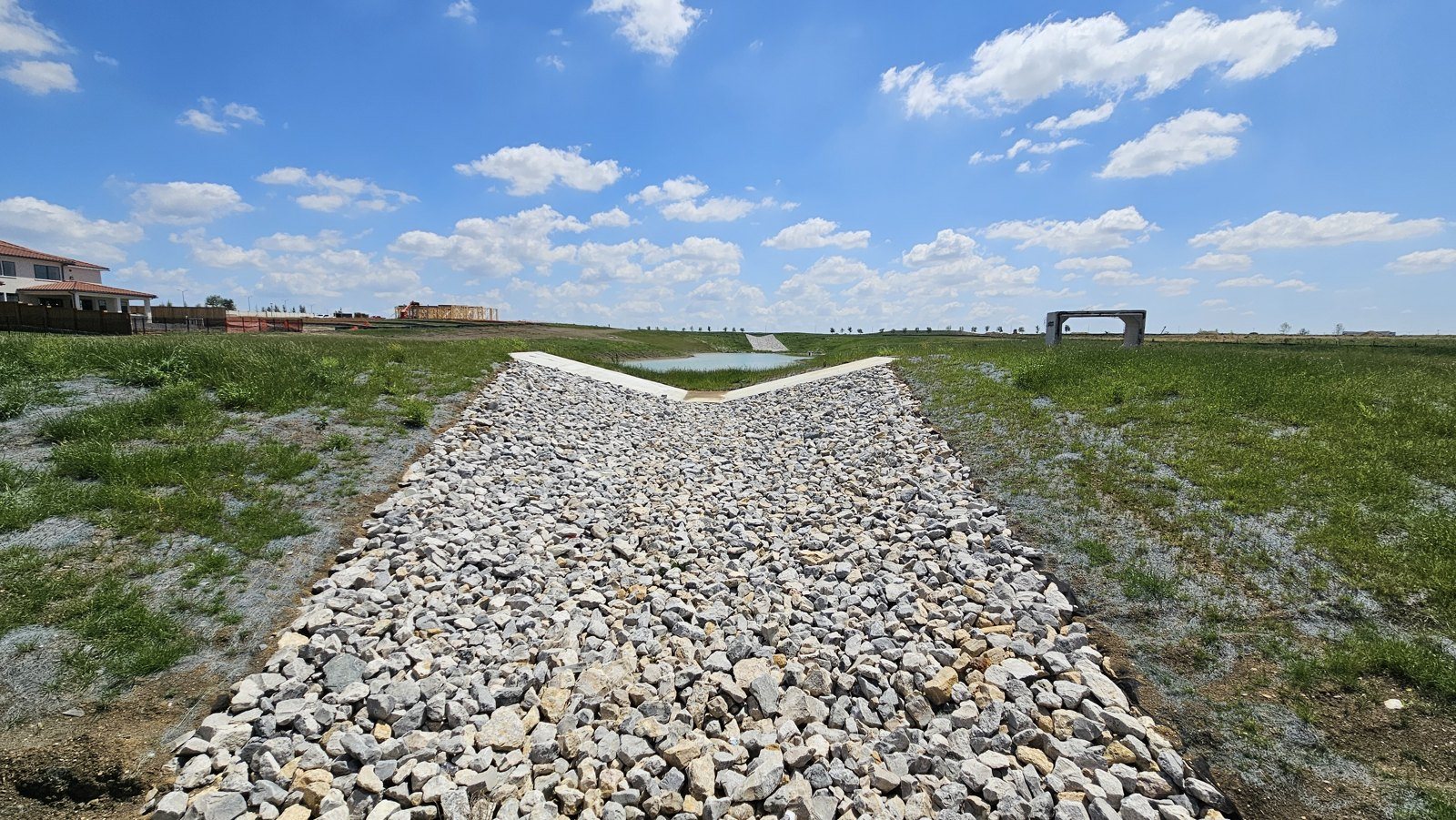
Rock is the oldest answer in erosion control because water has never beaten it — where concentrated flow exits a pipe or runs a bank, stone takes the energy that would otherwise take the soil. Riprap is that answer made permanent: sized rock, placed where the water hits hardest, doing quiet work for decades. Terradyne installs riprap across Texas on the outfalls, flumes, and channel banks where every storm concentrates.
What is riprap?
Riprap is placed rock armor for the points where flowing water concentrates. Terradyne installs riprap — large angular rock armoring outfalls, flumes, channel banks, and velocity-dissipation aprons. The angularity is the point: angular rock locks against itself under flow instead of rolling away the way rounded stone does.
The permit puts rock at every outfall
Riprap is not a decorative choice — the discharge end of a site is regulated ground. TXR150000 requires velocity dissipation devices at discharge locations and along the length of any outfall channel, to provide a non-erosive flow velocity from the structure to a water course. And rock's role does not end with construction. TXR150000 names riprap and gabions as examples of equivalent permanent stabilization measures. The same apron that protects the outfall during construction can be the permanent stabilization the closeout inspection accepts.
What the regional guidance specifies
The regional standard turns "put rock at the outlet" into an engineered practice. Under iSWM construction controls, velocity dissipation devices are required on all outlets where the design storm velocity exceeds 4 feet per second and the discharge is to an unlined or natural channel. iSWM identifies rock riprap as the most common material used for temporary velocity dissipation. What sits under the rock matters as much as the rock. iSWM guidance calls for riprap on a filter-fabric lining to prevent soil movement, with the fabric perimeter keyed into the ground a minimum of 6 inches. Rock dumped on bare clay pumps fines up through the voids until the apron sinks into the hole it dug for itself — the fabric is what makes the armor permanent.
The guidance also knows where rock stops working. iSWM does not allow riprap where there is a difference in elevation between the outlet and the receiving channel. Where the outlet sits higher than the channel, the fix changes shape — a stabilized grade break, not a flat apron. That is Gabion Basket & Mattress Installation territory, and the reason the two scopes so often ride the same bid.
Grouted or loose
The same rock does two different jobs depending on whether it is locked together. Terradyne's standard riprap section is 8-by-12-inch rock placed a foot deep, grouted or non-grout per the civil plans. Grouted riprap sets into a rigid, concrete-locked surface — a flume or spillway face that sheds water as a unit. Non-grout riprap stays loose and flexible, settling with the grade and self-healing when a stone shifts. The civil plans make the call, and the crews build to the sheet. The distinction matters at repair time too: a damaged grouted section gets cut out and re-poured like the slab it effectively is, while a loose section is repaired by exactly what built it — more rock, placed right.
What failing rock looks like
Riprap fails slowly and tells you about it. An apron that sits lower every season is pumping fines up through its voids — the rock is sinking into the soil it was meant to protect, which is the signature of a missing or failed filter fabric. Individual stones scattered downstream of the apron mean the design flow met undersized rock and moved it. A scour hole opening at the downstream end of the apron means the apron is shorter than the energy it receives — the water is re-concentrating right past the last stone. And an edge unraveling at the sides means flow is getting around the armor instead of over it. Each of those has a mechanical fix — fabric, heavier stone, a longer apron, keyed edges — and each gets more expensive the longer it runs. A rock section that gets a glance after big storms is a permanent asset; one that never gets looked at is a slow-motion excavation.
Frequently Asked Questions
Is it riprap, rip rap, or rip-rap?
All three spellings mean the same placed rock armor — plans and specs use riprap, rip rap, and rip-rap interchangeably. However it is written on the sheet, it is the same scope: sized angular rock placed to protect soil from concentrated flow.
When does an outfall need riprap?
Whenever discharge leaves a pipe, flume, or swale with enough velocity to erode the channel that receives it. If the water exits faster than the ground can take, the outlet needs an apron — and the design storm, not the dry-day trickle, is the test.
What is the difference between grouted and non-grouted riprap?
Grouted riprap is locked into a rigid concrete-bound surface that acts as one piece — the choice for flumes and steep faces. Non-grouted rock stays loose and flexible, settling with the grade and tolerating movement. The civil plans specify which one each location gets.
Can riprap fix a drop between an outlet and the channel?
No — a flat rock apron is the wrong tool where the outlet sits higher than the water that receives it. Elevation differences call for a stabilized grade break, which is where gabion drop structures take over.
Request a bid
Send your outfall schedule or channel sections to bids@terradynegroup.com or call (214) 878-7392 for riprap installation across Texas. Tell us the outlet count and whether the plans call for grout, and we will price the aprons as drawn. Vertical drops go to Gabion Basket & Mattress Installation, mowable armor to Flexamat, and the full family lives under Slope, Channel & Hard Armor.