
Rock Filter Dams (Rock Check Dams)
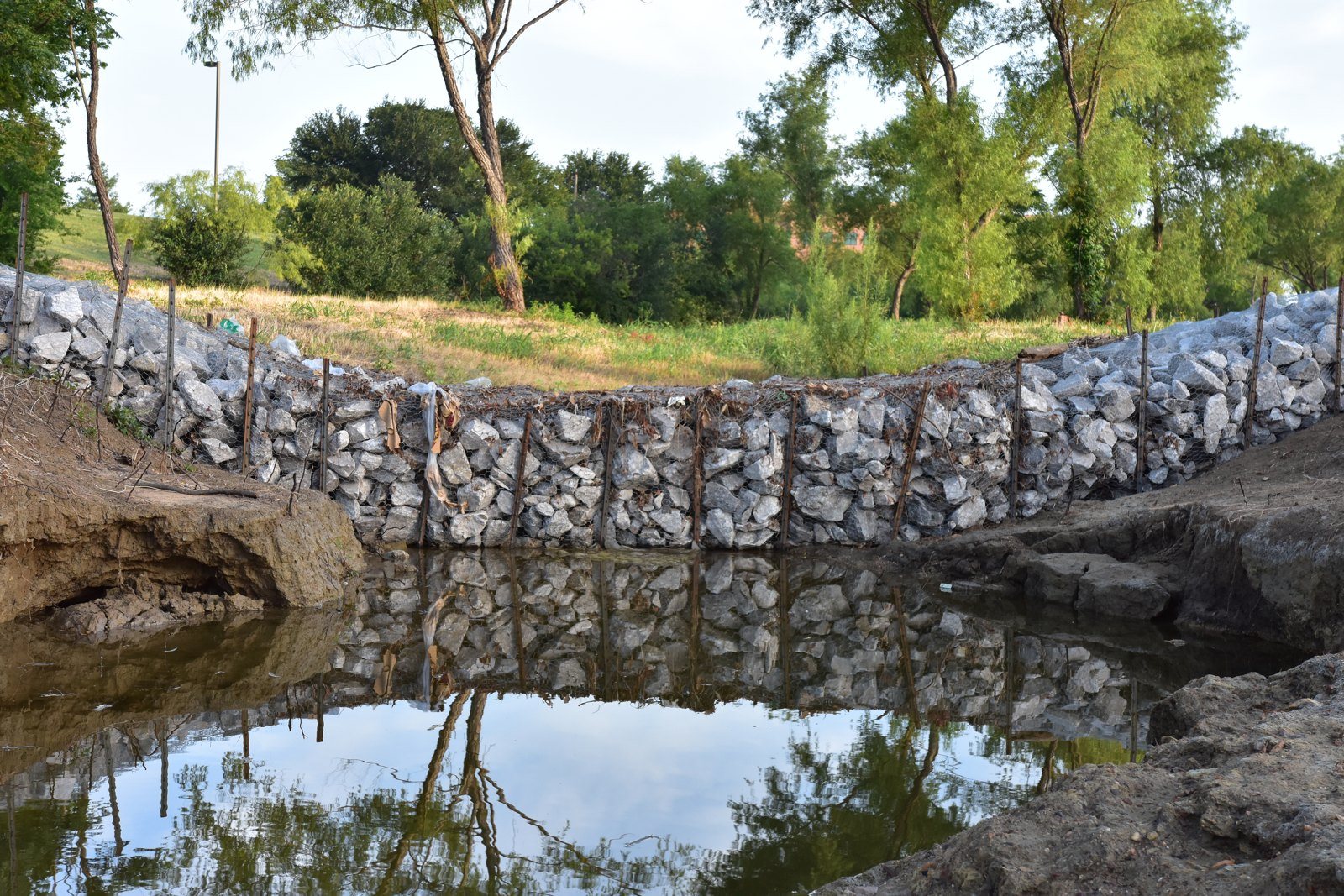
Water that concentrates is water that cuts. The ditch that carried a lazy trickle in the dry season becomes a channel mover in the first real storm, and whatever soil it picks up becomes somebody's sediment problem downstream. Terradyne installs rock filter dams across Dallas–Fort Worth to slow that water down where it runs hardest — in the ditches, swales, and channels a site cannot avoid having.
What is a rock filter dam?
A rock filter dam is a low berm of rock set across a ditch or swale to slow running water before it cuts and carries. Terradyne builds rock filter dams as wire-wrapped rock berms placed across ditches, swales, and channels — an in-channel sediment control that slows concentrated flow, ponds runoff, and drops sediment.
Rock filter dams vs. rock check dams
The name changes with the spec book — rock filter dam on state roadway jobs, rock check dam in the regional details and national guidance — same job in the ditch, with the exact build set by whichever book governs. EPA's check dam fact sheet describes check dams as relatively small, temporary structures constructed within concentrated-flow areas such as swales, channels, and ditches. Whatever your plan sheet calls it — ditch check, rock berm, sediment stone dam — you are pricing the same control for the same ditch, with the build details coming from whichever spec governs.
Where check dams go — and where they don't
A check dam is for concentrated flow — the ditch, the swale, the channel; silt fence is for sheet flow. Swapping one for the other is how both fail. EPA's fact sheet says construction staff should not use straw bales or silt fences as check dams, because neither is suitable for concentrated-flow areas. Placement in series has its own rule. EPA's fact sheet advises spacing check dams in series so the crest of the downstream dam sits at the same elevation as the toe of the upstream dam. Done right, the water steps down the ditch like a staircase instead of sliding down a ramp.
Design and spec
These are engineered controls, not rock piles. The iSWM detail requires the check dam's actual dimensions to be designed from flow conditions in the drainage swale or ditch, with calculations documenting the design parameters. The iSWM standard detail requires check dam stone to be well graded, with a size range from 1 1/2 to 3 1/2 inches in diameter depending on expected flows.
State roadway work runs heavier. TxDOT's Item 506 specifies 3-to-6-inch aggregate for Type 1, 2, and 4 rock filter dams, and 4-to-8-inch aggregate for Type 3. Item 506 requires minimum 20-gauge galvanized wire for the steel wire mesh and tie wires on Type 2 and Type 3 rock filter dams. On TxDOT projects, rock filter dams are placed perpendicular to the flow of the stream or channel unless otherwise directed.
Maintenance, cleanout, and removal
A check dam works by catching what the water drops, which means it slowly buries itself in its own success. Under the iSWM detail, silt must be removed from a check dam when it reaches a depth equal to one-third of the dam's height or one foot, whichever is less. The iSWM detail requires check dams to be inspected as specified in the SWPPP and replaced when the structure ceases to function as intended due to silt accumulation among the rocks, washout, or construction traffic damage. And the control is temporary by definition. Once the site achieves final stabilization or another erosion or sediment control device is employed, the iSWM detail requires the check dam and accumulated silt to be removed and disposed of in an approved manner.
How Terradyne builds them
Terradyne builds rock filter dams with 4-by-8-inch rock wrapped in wire mesh at 1.5-foot or 2-foot heights. The wire wrap is what keeps the section standing through repeated storms instead of washing flat into the ditch — loose rock spreads, wrapped rock holds its weir shape and keeps ponding where the design put the water. Terradyne has been setting rock in North Texas ditches since 1988, on hundreds of active sites across DFW. Pair the in-channel work with Silt Fence Installation on the sheet-flow perimeter and Storm Drain Inlet Protection where the ditch ends at an inlet, and browse the full Erosion Control division for the rest of the plan sheet. For lighter contour work on slopes, Sediment Logs & Wattles do the job rock should not.
Frequently Asked Questions
Is a rock check dam the same as a rock filter dam?
Same control, different spec books. Roadway specifications say rock filter dam and add wire wrapping on certain types, while the regional details and national guidance say rock check dam and build with graded stone. If your plans say ditch check or rock berm, you are still reading about the same control doing the same job — the governing spec sets the build.
When does the silt behind a check dam get cleaned out?
When it stacks up to about a third of the dam's height — or a foot, whichever comes first — the silt comes out. Waiting longer turns the dam into a speed bump that water flows around, which is when the ditch starts cutting at the banks instead.
What rock goes into a rock filter dam?
Well-graded stone sized to the expected flow, held in a wire-mesh wrap on the heavier builds. The governing detail sets the size range — the specific numbers are in the design and spec section above, for both regional and state roadway work.
Can I just run silt fence across the ditch?
No. Silt fence is a sheet-flow control; concentrated flow undercuts it, flattens it, and takes it downstream. National guidance says the same thing — ditches and swales get check dams, not fence or straw bales.
Request a bid
Send your drainage plan to bids@terradynegroup.com or call (214) 878-7392 for rock filter dam installation. Tell us the ditch lengths and the governing spec, and we will bring the rock, the wire, and the maintenance schedule that keeps the control working.