
Coir / Coconut Erosion Mat (C-350)
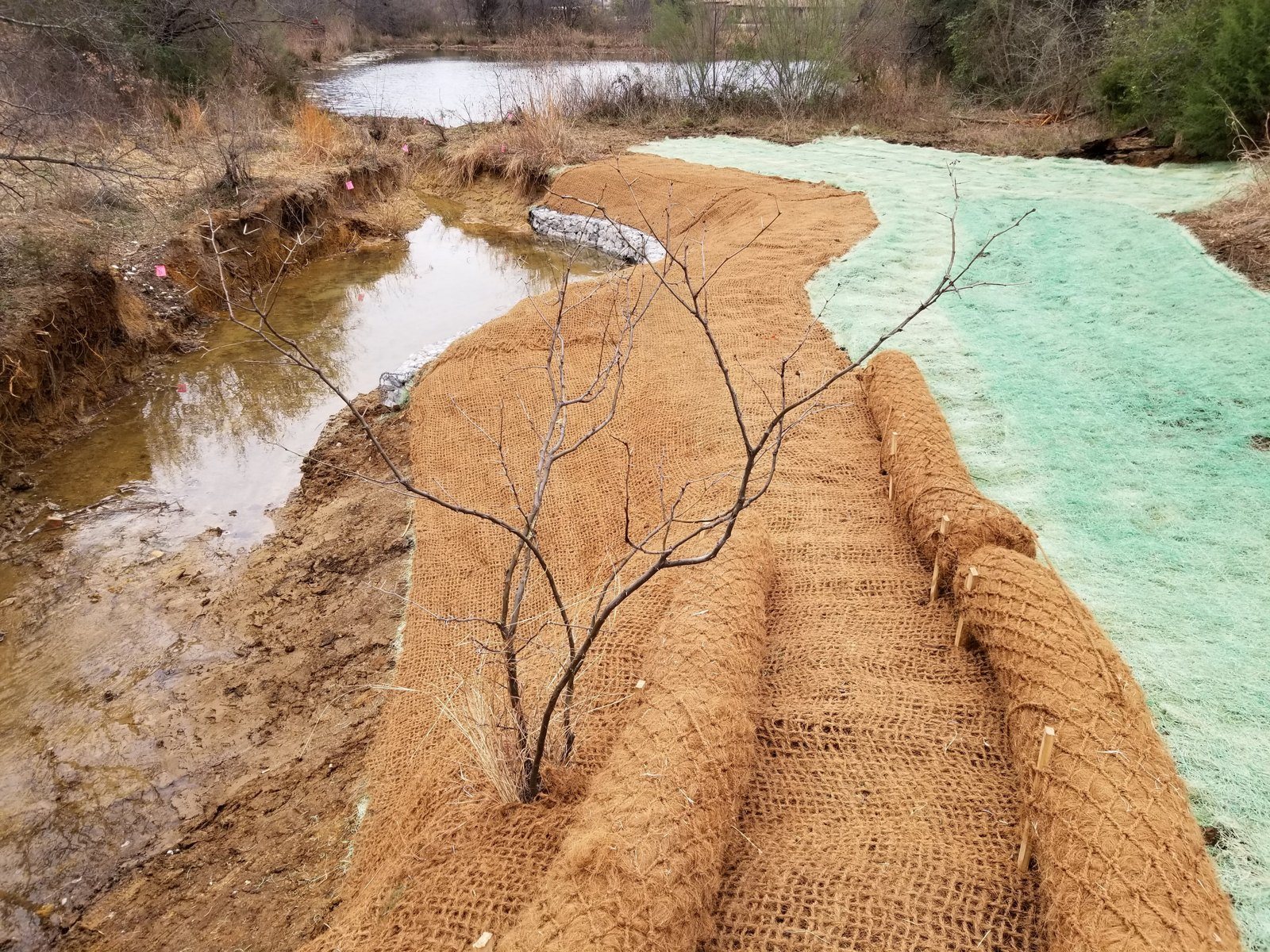
For a degradable option built to last through a longer establishment period, a coir (coconut-fiber) mat is the natural step up before a permanent turf reinforcement mat. Terradyne supplies and installs coir mats on the Dallas-Fort Worth slopes and channels where the grass needs more time than a lighter blanket gives it.
What is a coir erosion mat?
Coir is fiber that comes from the husk of a coconut. Woven or stitched into a rolled mat, it does the same job every blanket in this family does - hold the soil and the seed together until the vegetation can hold them itself.
Where it sits in the blanket family
The dividing line in this product family is what the mat is made of and what happens to it later. Erosion control blankets are degradable rolled erosion control products (RECPs), while turf reinforcement mats are RECPs that contain synthetic components. A coir mat sits at the heavy end of the degradable side - all natural fiber, no permanent synthetics - which is why plan sheets reach for it when a slope or swale needs protection through a longer establishment window but the design does not call for a permanent mat. The full family lives at EC Blankets, and the permanent step beyond it at Turf Reinforcement Mats (TRM).
Why blankets go down at all
The clock behind blanket work is regulatory, not cosmetic. TXR150000 requires erosion control and stabilization measures to be initiated immediately in areas where construction activities have temporarily ceased and will not resume for a period exceeding 14 calendar days. A seeded slope with a mat over it is that requirement being met - and a coir mat is the version of it that keeps working while deeper-rooted cover takes its time.
How Terradyne installs it
The blanket is only as good as its contact with the soil - the edges, ends, and anchors are where an installation earns its keep. The regional standard writes that down in numbers. The iSWM erosion control blanket detail requires a minimum 4-inch side overlap between adjacent blankets. The iSWM blanket detail requires a minimum 3-foot overlap at blanket ends, with the higher-elevation blanket overlapping on top of the lower blanket. And the edges get buried, not just pinned. The iSWM blanket detail buries the up-channel end of the blanket in a 6-inch by 6-inch trench, with anchor trenching located along the entire perimeter of the installation. Terradyne's crews install coir to the controlling detail on the plan - overlaps, trenches, and anchors included - so the mat that goes down is the mat the inspector signs off on.
Frequently Asked Questions
What do plan sheets mean by C-350?
It is a designation that shows up on erosion control plans for heavyweight all-coir mats. When your sheet calls for one, this is the product family it points at - confirm the exact specified product against the plan detail before ordering, since designations vary by manufacturer.
When does a coir mat make more sense than a straw blanket?
When the vegetation needs protecting longer than a light blanket is built to last - slower-establishing seed mixes, tougher slopes, or channels where the design stops short of a permanent mat. The controlling plan detail has the final word on which product the site gets.
Is a coir mat permanent?
No - it is a degradable product. The mats that stay for good are the synthetic-bearing turf reinforcement family; coir does its work while vegetation establishes and then gives the slope back to the grass.
Does the install really matter that much?
It is most of the product. Overlaps, buried ends, and perimeter anchoring are what keep water from getting under the mat - the failure mode that takes the soil and the seed with it. The regional detail specifies each of those, and the crew's job is to match it.
Request a bid
Send your slope or channel plan sheet to bids@terradynegroup.com or call (214) 878-7392 for coir mat supply and installation across Dallas-Fort Worth. The rest of the degradable family lives at EC Blankets, and the division hub at Erosion Control.