
Flexamat Flexible Concrete Mat
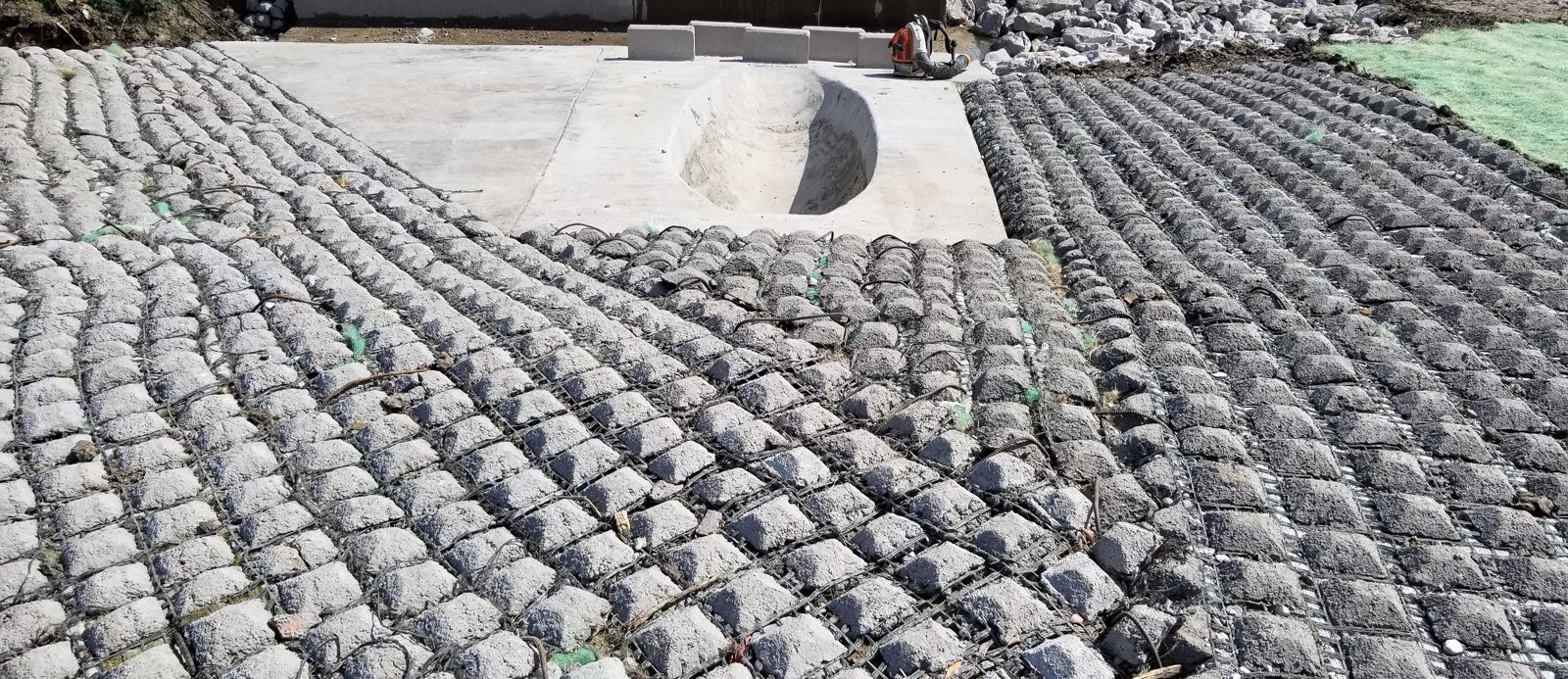
Flexamat solves the argument between hard armor and green space by being both — concrete where the shear hits, grass everywhere in between. It is the armor for the places that still have to look and work like landscape: the channel a crew must mow, the slope a resident sees, the section maintenance still has to reach. Terradyne installs Flexamat across Dallas–Fort Worth and Texas where the protection has to be permanent but the surface has to stay usable.
What is Flexamat?
Flexamat is a tied concrete block mat — permanent hard armor that arrives rolled up on a truck. Terradyne installs Flexamat — articulated concrete blocks cast on a geogrid mat that rolls out as hard armor and stays vegetated between the blocks.
The blocks take the flow; the gaps between them grow grass; the geogrid underneath ties every block to its neighbors so the mat flexes with the grade without coming apart. It is the middle answer the hard-armor family was missing — more armor than a reinforced grass mat, more landscape than a rock section.
Armor you can mow
The vegetated joints are what separate Flexamat from a rock section. Terradyne places Flexamat as permanent vegetated hard armor on channels and slopes. Where the surface must double as access — a maintenance path, a mowable channel — the tied-block format is what keeps the armor usable. A riprap channel is protected but lost to use; a Flexamat channel is protected and still part of the site.
A category the regional guidance recognizes
Articulated concrete block armor is an engineered velocity-dissipation option in the regional standard, on the same terms as rock and baskets. Under iSWM, articulating concrete blocks may be used for velocity dissipation when the designer provides calculations that document the size and dimensions for the design storm flow rate and velocities. The mat is chosen by the numbers — flow rate, velocity, section — not by catalog preference.
Permanent, in the permit's terms
The vegetated block mat plays directly into the compliance endgame. Final stabilization under TXR150000 requires uniform perennial vegetative cover of at least 70% of native background density, or equivalent permanent stabilization measures. A Flexamat section covers both halves of that sentence at once — a permanent measure that also grows the vegetative cover through its joints. That dual identity is worth real money at closeout: the section does not wait on grass density arguments the way a plain seeded channel does, and it does not trade away the green finish the way a rock section would. It is finished when it is built, and greener every season after.
Rolled out, not placed block by block
The roll-out format is the labor story: armor that arrives as a mat and unrolls onto prepared grade instead of being placed a block at a time. Subgrade preparation is most of the craft — the mat wants smooth, compacted, seeded grade with no voids underneath, and it rewards that preparation by going down in panels instead of pieces. Anchoring and edge terminations follow the design, and the grass does the rest of the finishing. Panel joints get tied per the detail, terminations get keyed so flow cannot get under the first block, and the seeded joints get the same establishment care as any other planted surface on the site.
Reading a section after a storm
An installed mat makes its own inspection easy. Healthy sections read uniform: blocks seated, joints green or greening, edges tight to the terminations. The warning signs are just as legible. A block row standing proud of its neighbors means the subgrade settled or washed underneath — water found a void and is working on it. Bare joints in a section that should have grown in mean the soil beneath ran short or the water never came, and bare joints are how a vegetated mat slowly becomes just a mat. And an edge lifting at a termination is the one to fix the week it appears, because every storm after that has a handle to pull on. All three trace back to preparation and establishment rather than the product — which is the pattern with every armor on this page: the material is rarely the failure; the ground it sits on usually is.
Frequently Asked Questions
What is a tied concrete block mat?
A mat of concrete blocks cast onto a geogrid so the blocks act together — flexible enough to follow the grade, heavy enough to hold under flow, with open joints that vegetate. It installs by unrolling panels rather than setting individual blocks.
Can you drive on Flexamat?
It is armor first and pavement never. The format's appeal is that crews and mowers can cross it for maintenance, unlike loose rock — but any regular traffic use is a design question for the engineer of record, not a catalog promise.
Does grass really grow through it?
Yes — the joints between blocks are open to the seeded soil below, and the established surface reads as a green channel with concrete knuckles. The vegetation is functional, not cosmetic: it is part of how the section meets the permanent-cover standard.
When is Flexamat the wrong choice?
Where the design flow exceeds what an articulated mat can hold, or where a vertical drop needs a structure instead of a lining. The high-shear extremes go to engineered anchored systems or gabion drops — the calculations, not the catalog, make the call.
Request a bid
Send your channel or slope sections to bids@terradynegroup.com or call (214) 878-7392 for Flexamat installation across Dallas-Fort Worth and Texas. Tell us the section lengths and the design flows, and we will price the mat as engineered. Loose rock lives at Riprap, the reinforced-grass option at Turf Reinforcement Mats (TRM), and the full family under Slope, Channel & Hard Armor.