
Gabion Basket & Mattress Installation
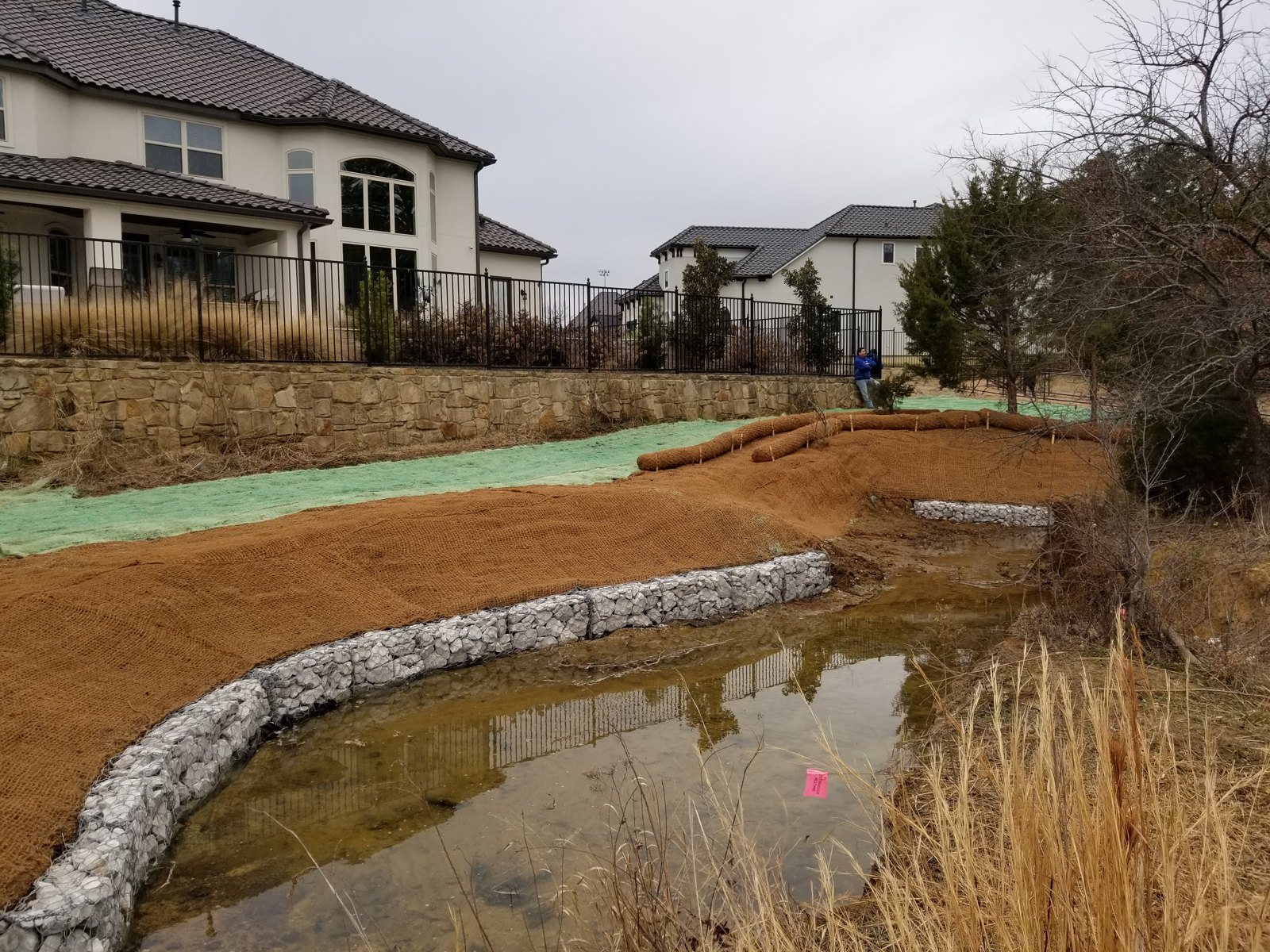
A gabion is rock that holds a shape — the wire basket turns loose stone into a stackable structural unit, which is how rock ends up doing retaining-wall work. Where a slope needs holding, a channel needs lining, or water needs to step down without tearing the grade, the basket is the answer that is still standing decades later. Terradyne builds gabion structures across Texas — mattresses and channel linings first. Terradyne's gabion focus is mattresses and low structures — channel linings, grade breaks, and toe courses — not tall vertical retaining walls.
What is a gabion?
A gabion is a wire basket engineered to be filled with rock and assembled into structures that stand. Terradyne builds gabion walls and baskets — wire baskets filled with rock, stacked and tied into gravity walls, channel linings, and drop structures.
The filled baskets work by mass and drainage at once: heavy enough to hold ground, open enough to let water through without building pressure behind the wall. That free-draining weight is the whole trick — the classic enemy of a solid retaining wall is the water trapped behind it, and a gabion never traps any.
Where the basket beats the apron
Flat energy problems take an apron; vertical ones take a structure. When the water has to step down, the basket is what holds the step. The regional guidance draws the same line. iSWM directs that gabion drop structures or other stabilized grade breaks be installed where an elevation difference exists at the outlet, until permanent structures are installed. That is the niche loose rock cannot fill — a Riprap apron protects grade; a gabion drop structure replaces it where the grade itself has to change.
Engineered, not stacked
A gabion structure is a designed thing, not a pile with a cage on it. Under iSWM, gabions may be used for velocity dissipation when the designer provides calculations that document the size and dimensions of the device for the design storm flow rate and velocities. The basket sizes, the rock gradation, the tie pattern, and the founding grade all come off the design — which is why the same crews that place the rock also read the sections. That engineering is also what a reviewer asks for first: a gabion submittal travels with its calculations, and a structure built to them closes out without argument. The improvised version — baskets bought by catalog and stacked by feel — is the one that ends up in front of an engineer after it moves.
The permit's permanent option
Gabions are written into the compliance endgame by name. TXR150000 names riprap and gabions as examples of equivalent permanent stabilization measures. Final stabilization under TXR150000 requires uniform perennial vegetative cover of at least 70% of native background density, or equivalent permanent stabilization measures. Where a bank or grade break will never hold grass, the basket is a closeout answer the permit already accepts.
Living with wire
A gabion's service life is a maintenance story. Terradyne maintains gabions against wire corrosion and rock loss. Wire that rusts through lets the basket relax and the structure slump; rock that migrates out of a torn face leaves voids that concentrate the next failure. Both start small and visible, which is why a gabion inspection is cheap and a gabion rebuild is not. A short walk along the wall after each wet season — eyes on the faces, the ties, and the toe — is the entire preventive maintenance program.
How a basket goes together
Gabion work is assembly, and the craft is in the sequence. The founding grade comes first — a basket set on soft or unlevel ground telegraphs every settlement up through the courses above it. The empty baskets are laced or ring-tied to their neighbors before any rock goes in, so the wall behaves as one mass instead of a row of boxes. Fill placement is not a dump: exposed faces get hand-placed stone tight enough to look built, interiors take machine fill, and internal bracing wires keep the faces from bellying while the rock goes in. Lids come last, tensioned and tied, and the next course starts on a closed, true box. Every one of those steps shows in the finished wall — a wavy face or a bulged basket is a record of the shortcut that made it.
Frequently Asked Questions
What is the difference between gabions and riprap?
Riprap is loose placed rock — an apron or blanket that protects grade. A gabion is rock confined in an engineered wire basket, which lets it stand vertically and carry structural load. Flat protection goes to rock; steps, walls, and drops go to baskets.
Do gabion structures need engineering?
Yes. Basket sizes, rock gradation, and the structure's dimensions come from design calculations for the flow they must survive — a gabion is a designed structure, not a stacked pile. The crews build to the sections, not to eye.
How long do gabion walls last?
Decades, when the two failure modes are watched: wire corrosion and rock loss. The structure fails slowly and visibly — rust and relaxed faces show long before collapse — so periodic inspection keeps a long service life honest.
Can gabions work as a retaining wall?
They can — stacked baskets hold by mass while draining freely, which spares them the water pressure that plagues solid walls. Terradyne's focus, though, is mattresses and low structures; tall vertical walls are structural scopes we generally pass to the wall trade.
Request a bid
Send your channel or mattress sections to bids@terradynegroup.com or call (214) 878-7392 for gabion basket and mattress installation across Texas. Tell us the heights and the rock spec, and we will price the structure as designed. Flat armor lives at Riprap, vegetated block mat at Flexamat, and the full family under Slope, Channel & Hard Armor.