
Erosion Control Blankets
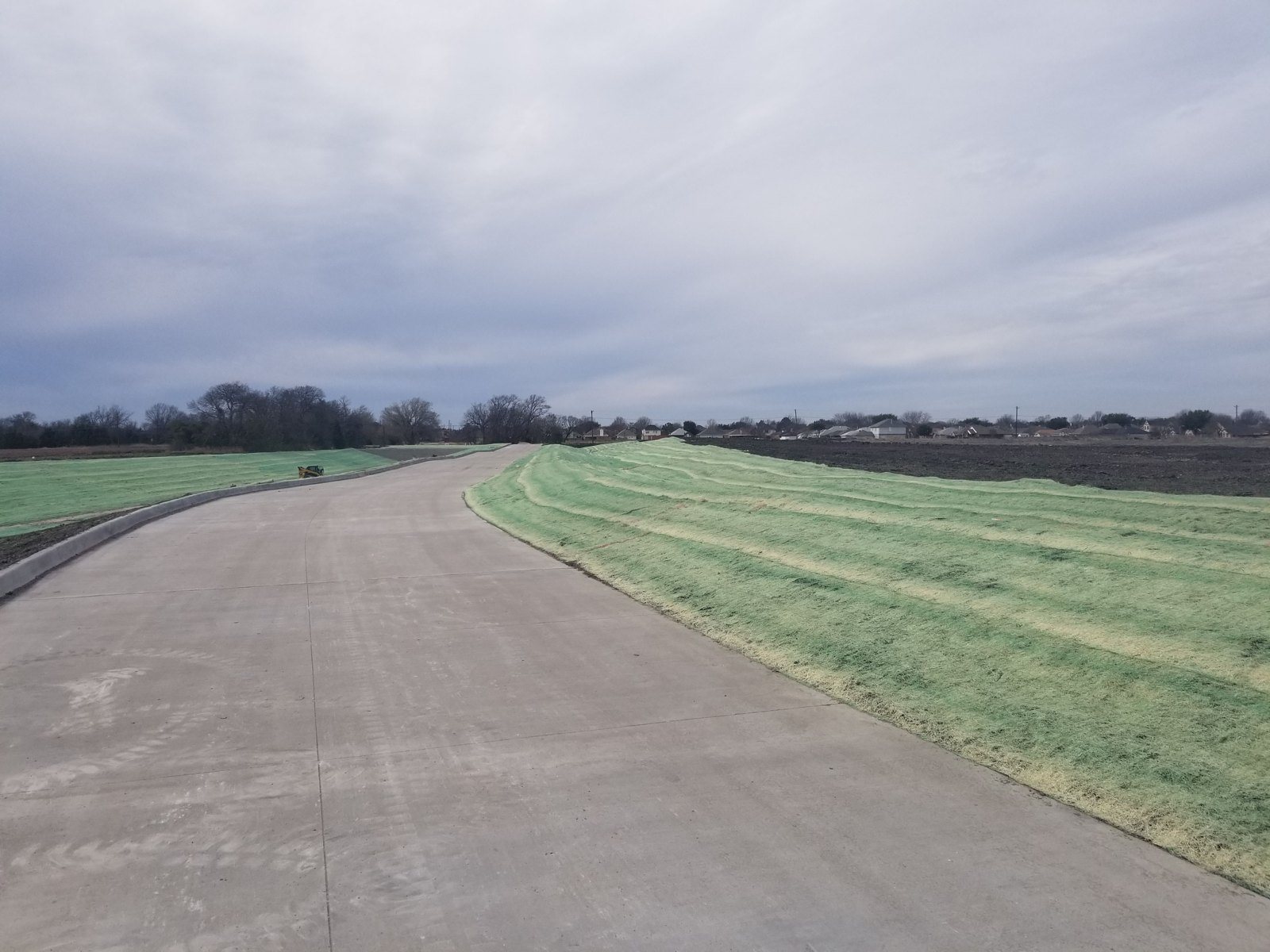
A freshly graded slope is bare, loose, and one storm away from a mud fan across the sidewalk. Seed alone will not hold it — the rain moves the soil before the roots can. An erosion control blanket is the cover that buys the grass time, and on a Dallas–Fort Worth slope it is often the fastest way to turn raw dirt into a stabilized face that a reviewer will pass. Terradyne installs erosion control blankets across DFW, matched to the slope, the seed, and the detail your city enforces.
What is an erosion control blanket?
An erosion control blanket is a biodegradable mat laid over freshly seeded ground. On a graded slope, an erosion control blanket holds seeded soil in place and keeps rainfall from washing it away until the grass roots take hold. Erosion control blankets are degradable rolled erosion control products (RECPs), while turf reinforcement mats are RECPs that contain synthetic components.
The clock that makes blankets necessary
Bare graded ground is a finding waiting for rain, and the permit puts a clock on it. TXR150000 requires erosion control and stabilization measures to be initiated immediately in areas where construction activities have temporarily ceased and will not resume for more than 14 calendar days. On a slope that is done being cut but not ready to pave, a blanket over seed is the control that answers that clock. The finish line is written down too. Final stabilization under TXR150000 requires uniform perennial vegetative cover of at least 70% of native background density, or equivalent permanent stabilization measures. The blanket's entire job is to carry the seed to that cover before the inspector arrives to check for it.
What the regional detail requires
Blankets are not just rolled out and forgotten — the governing detail carries real rules. The iSWM construction-control standard details include a standard detail for temporary erosion control blankets. The iSWM erosion control blanket detail requires a minimum 4-inch side overlap between adjacent blankets. The iSWM blanket detail requires a minimum 3-foot overlap at blanket ends, with the higher-elevation blanket overlapping on top of the lower blanket. That shingle direction matters: lap it the wrong way and runoff runs under the blanket instead of over it.
Anchoring is where most blanket failures start. The iSWM blanket detail buries the up-channel end of the blanket in a 6-inch by 6-inch trench, with anchor trenching located along the entire perimeter of the installation except small areas under 2% slope. The staples hold the rest. In the absence of manufacturer literature, the iSWM blanket detail specifies minimum 11-gauge wire staples 6 inches long and 1 inch wide. And the detail is honest about where it applies. The iSWM erosion control blanket staple pattern is specified for slope protection, not channels.
The blanket built in our backyard
Not every blanket is the same fiber, and one of the most familiar names is made close to home. American Excelsior Company, inventor of the Curlex brand of biodegradable erosion control blankets, is headquartered in Arlington, Texas. Their excelsior blankets are a DFW-native answer to a DFW slope. Curlex NetFree blankets are made from interlocking, curled Great Lakes aspen fibers that require no netting to hold their structure. That netting-free build is why a fully biodegradable blanket leaves nothing behind to snag a mower or trap wildlife once the grass has won.
Blanket, mat, or coir — matching the cover to the job
The blanket is one member of a family, and the right pick depends on how hard the ground will be worked. Blankets are the degradable half of the family; where flow concentrates in a channel or the lining has to be permanent, the reinforced answer is a turf reinforcement mat. For a degradable option built to last through a longer establishment period, a coir (coconut-fiber) mat is the natural step up before a permanent turf reinforcement mat. If your slope is really a channel, start with Turf Reinforcement Mats (TRM); if it needs a longer-lived degradable cover, look at the Coir / Coconut Erosion Mat; and the full Stabilization & Revegetation group covers seeding and the rest.
How Terradyne installs
Terradyne installs erosion control blankets to the governing iSWM standard detail and the manufacturer's published literature, then checks every blanket for full soil contact and secure staples. A blanket that bridges over a clod or lifts at a loose staple is a blanket that fails at the first storm, so the walk-back after install is part of the scope, not an extra.
Frequently Asked Questions
What is an erosion control blanket used for?
It holds seeded soil on a graded slope so rainfall cannot wash it off before the grass establishes. The blanket is temporary and biodegradable — it protects the seedbed, then breaks down as the vegetation that replaces it takes over the job of holding the slope.
When does a slope need a blanket instead of just seed and mulch?
Whenever the slope is steep enough or the timing tight enough that loose seed would wash before it germinates. On DFW clay slopes that sit exposed through a wet stretch, a blanket is cheap insurance against reseeding the same face two or three times.
Do erosion control blankets meet the permit's stabilization requirement?
A blanket is a stabilization measure that gets you started on the permit clock and carries the seed toward permanent vegetative cover. It is the means, not the finish — the requirement is met when the vegetation underneath reaches the required density.
What is the difference between an erosion control blanket and a turf reinforcement mat?
A blanket is degradable and temporary; a turf reinforcement mat is permanent and reinforced for concentrated flow. Slopes that just need cover until grass roots take a blanket; channels and spillways that carry water year-round take a mat.
Request a bid
Send your grading and landscape plan to bids@terradynegroup.com or call (214) 878-7392 for erosion control blanket installation across Dallas–Fort Worth. Tell us the slope areas and seed spec on your plan, and we will match the blanket to the detail your city enforces. The full Erosion Control division covers the perimeter, inlet, and channel controls that work alongside it.