
Sod Installation
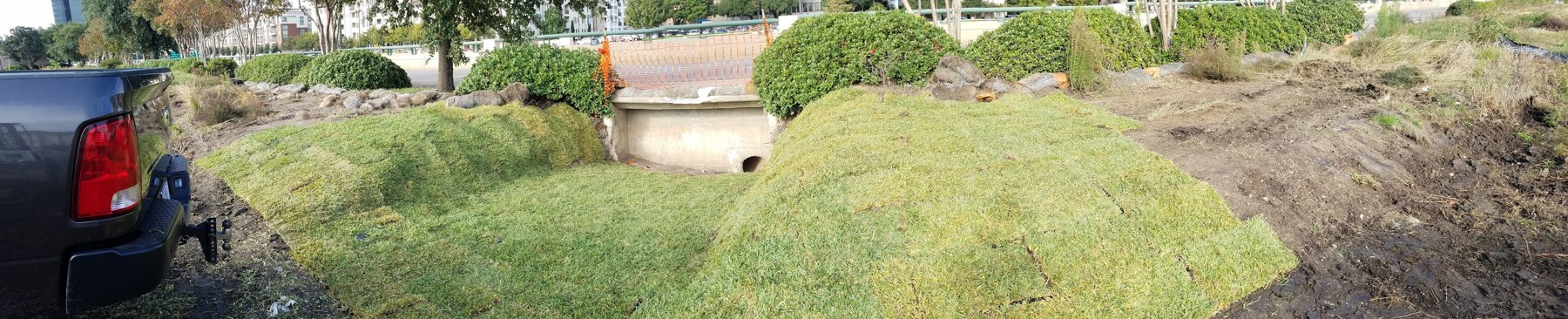
Sod is stabilization you can stand on the same day it goes down — the grass arrives grown, and the erosion protection starts at the first roll. No germination window, no waiting on the weather, no month of hoping the storm holds off. Terradyne installs sod across Dallas–Fort Worth where the ground has to be finished now: lawns ahead of a closing date, swales that flow next week, and the bare strips a final inspection keeps failing.
What does sod installation cover?
Sod installation is the direct route from bare dirt to established-looking turf. Terradyne places common bermuda sod for instant permanent vegetative stabilization on lawns, swales, and small disturbed areas. It is the stabilization method for the places that cannot wait on seed.
The instant-cover practice
Sod is a recognized erosion-control practice, not just a landscaping finish. Sodding is a permanent erosion control practice that involves laying a continuous cover of grass sod on exposed soils. Its niche is exactly where seed struggles. Sodding can provide immediate vegetative cover for critical areas and stabilize areas where seeding is not an option. A swale that takes flow before a stand could establish, a slope face the schedule will not protect for a month, a strip the city walks tomorrow — those are sod jobs. The economics only look lopsided until the second seeding invoice arrives: on small critical areas, paying once for instant cover routinely beats paying twice for slow cover that washed out in between.
Fresh sod or failed sod
The product is alive, and the clock on it is short. Sod should be installed no more than 36 hours after harvest so it arrives healthy and living. Pallets that sit heat up from the inside, and turf laid yellow does not recover into a stand — it becomes a re-do with a delivery fee. That is why the order and the crew get scheduled as one motion: the harvest date is set against the lay date, and the pallets hit ground that is already prepped to receive them. Fresh harvest, quick lay, and water behind the roller is the difference between instant cover and expensive compost.
The finish line it reaches first
The regulatory endgame for every stabilization method is measured in living cover. Final stabilization under TXR150000 requires uniform perennial vegetative cover of at least 70% of native background density, or equivalent permanent stabilization measures. Sod starts at full cover the day it is laid — establishment is about the roots knitting down, not the surface filling in. That inversion is what makes it the closer's tool: every other method builds toward the density the inspection measures, while sod starts there and spends its establishment period earning the right to stay.
Sod or seed
Where budgets favor seed over sod, the trade is time — seeded ground needs weeks of protection that sodded ground never asks for. Broad open areas with room on the calendar go to Seeding or Hydromulching; the strips, swales, and deadlines get sod. Most sites end up using both, split along exactly that line — acreage on seed, criticals on sod — which is why the two scopes usually price together. The full decision map lives under Stabilization & Revegetation.
How a sod job runs
Good sod work is mostly what happens before and after the rolls. The subgrade gets finished smooth and moist — sod laid over clods and voids bridges them, and bridged roots dry out and die in stripes. The rolls go down tight: joints butted, seams staggered like brickwork, edges snugged so there is no exposed soil line for water to find. On slopes the courses run across the grade, not down it, and steep faces get staked so the whole mat cannot creep before it roots. Behind the last roll comes the roller, pressing root-to-soil contact along every seam — and behind the roller comes the water, because the first soak matters more than any that follows it.
What failed sod looks like
The failure signatures show early. Edges curling up mean the joints were loose or the water came late. Brown stripes across a smooth lawn mean the subgrade bridged. A mat that shifts underfoot on a slope was never staked. Each one traces back to the install day, which is why the crew that lays it right the first time is the whole product. Sod forgives very little and hides even less — but done fresh, tight, and wet, it is the one stabilization method that looks finished the same afternoon it goes down.
Frequently Asked Questions
How fast does sod protect a slope?
Immediately. The cover arrives grown, so raindrop impact and surface wash are handled from the first roll — establishment is about the roots knitting into the soil underneath, not about waiting for cover to appear.
Why does sod freshness matter?
Because the product is alive. Pallets that sit too long after harvest heat up and yellow from the inside, and stressed turf laid late struggles to root. The cut-to-laid window is measured in hours, not days.
Where does sod beat seed?
Anywhere the ground cannot wait: swales that will carry flow soon, finished lawns ahead of a closing, and the bare strips holding up a final walk. Seed wins on big open areas with time; sod wins wherever time is the constraint.
Does sod need anything after it goes down?
Water, promptly and consistently, while the roots knit down. The laying is the fast part — the watering schedule behind it is what turns instant cover into a permanent stand.
Request a bid
Send your landscape plan to bids@terradynegroup.com or call (214) 878-7392 for sod installation across Dallas-Fort Worth. Tell us the square footage and the date the ground has to be green, and we will schedule the harvest to the lay.